For businesses moving large numbers of empty steel drums, packaging shape can make a measurable difference. Conical drums have a tapered profile that allows them to nest inside one another, helping more empty containers fit into each delivery.
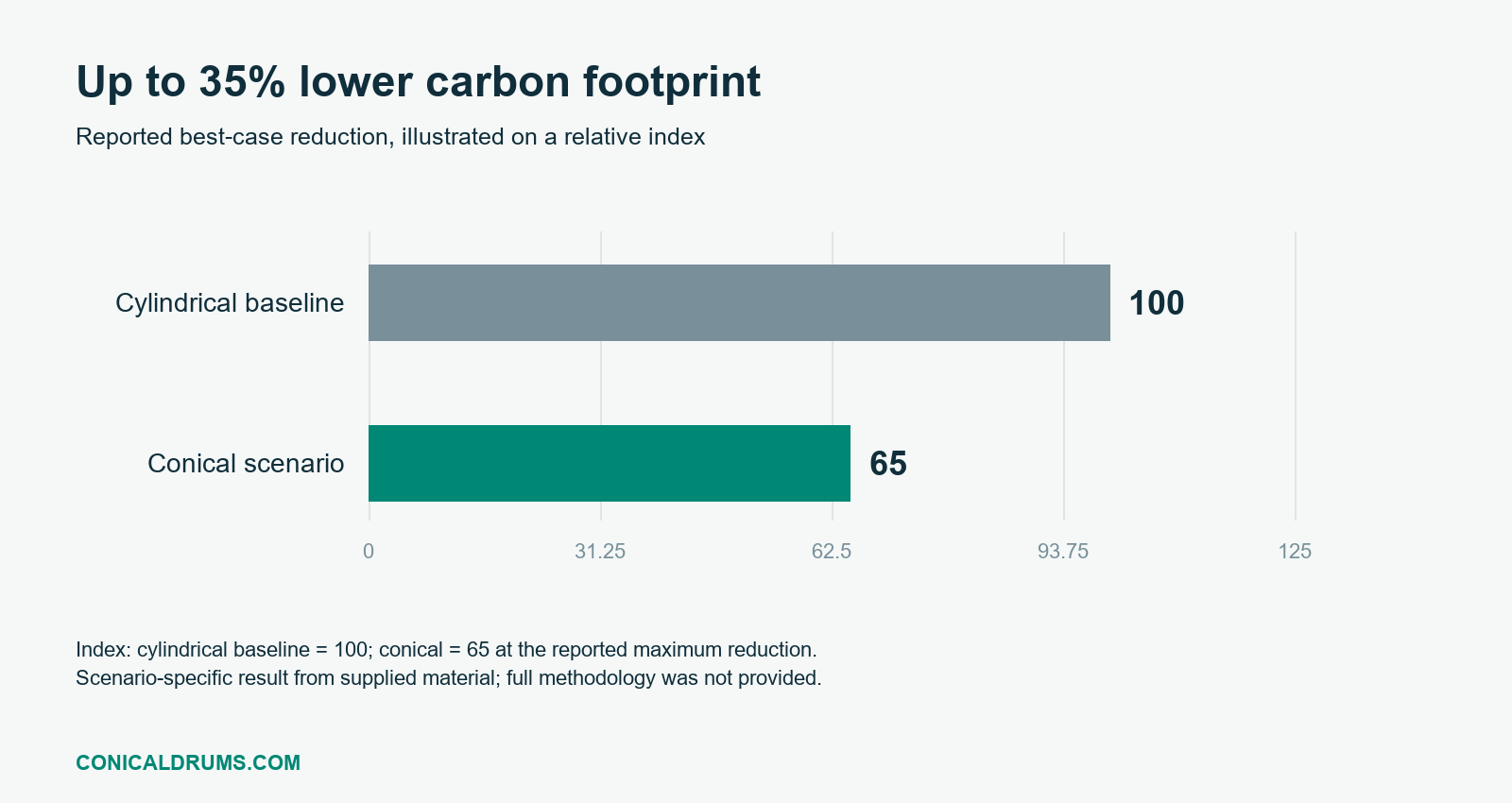
A supplied comparative analysis reported up to a 35% lower carbon footprint for conical steel drums than standard cylindrical drums under its selected parameters. Two factors explain the reported advantage: lower material use in some drum designs and more efficient transportation of empty drums.
Why the tapered design matters
Standard cylindrical drums occupy substantial space even when empty. Nestable conical drums use that space more efficiently, allowing multiple drums to share a smaller transport footprint.
The supplied comparison used loading figures of 2,000 empty conical drums with lids per truck, versus 288 standard cylindrical drums. That works out to approximately 6.9 times as many empty drums per truck.
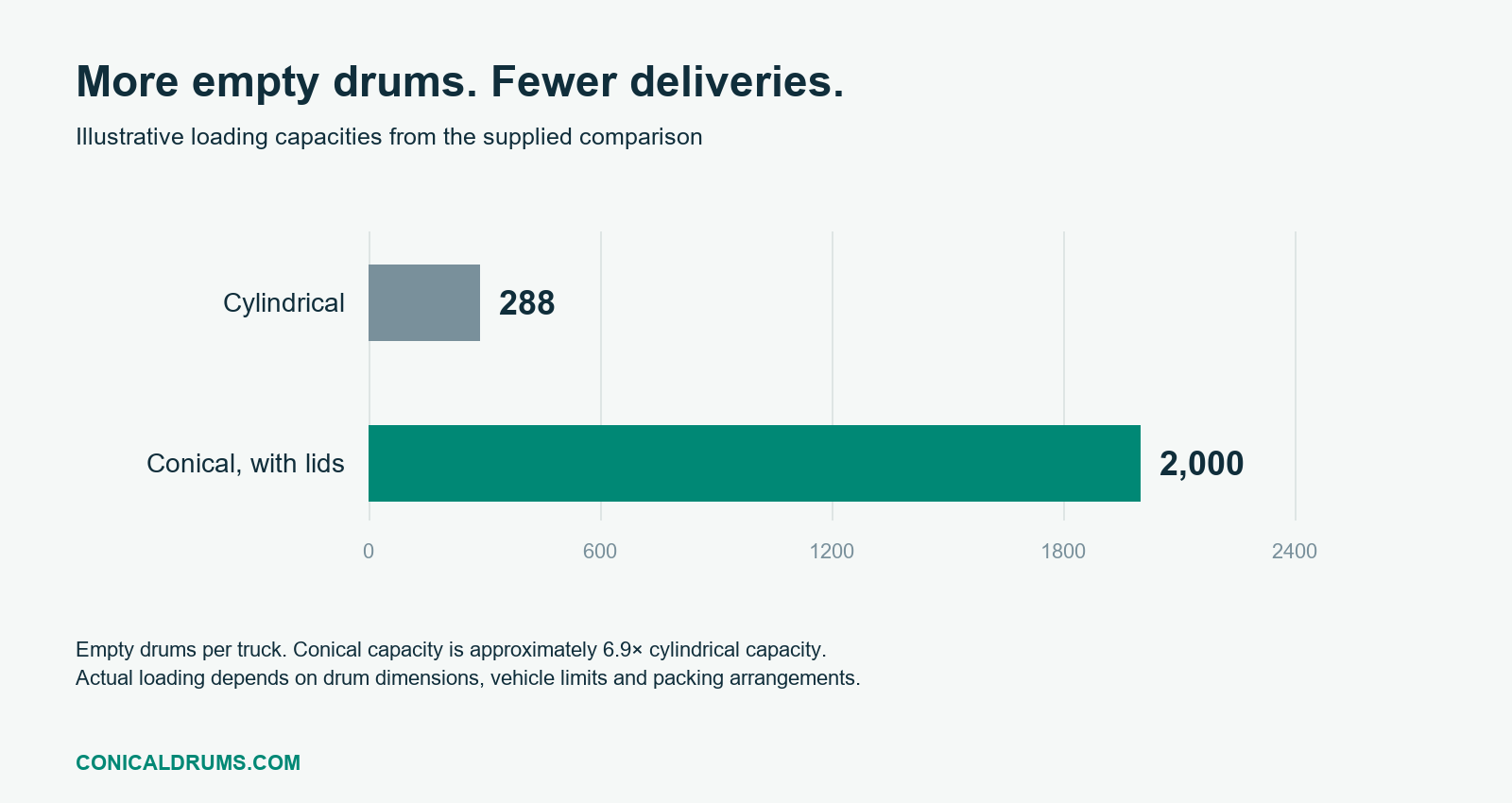
These figures describe empty-drum logistics. Actual loading capacity depends on drum dimensions, nesting arrangements, lids, vehicle configuration and applicable load limits.
What that means for an order of 10,000 drums
Using those loading assumptions, delivering 10,000 empty drums would require:
| Drum type | Empty drums per truck | Truckloads required |
|---|---|---|
| Standard cylindrical | 288 | 35 |
| Conical | 2,000 | 5 |
That is 30 fewer truckloads, or approximately 86% fewer loads, with partially filled final loads rounded up to whole truckloads. For a buyer, the practical opportunity is fewer inbound deliveries and less vehicle space devoted to empty packaging.
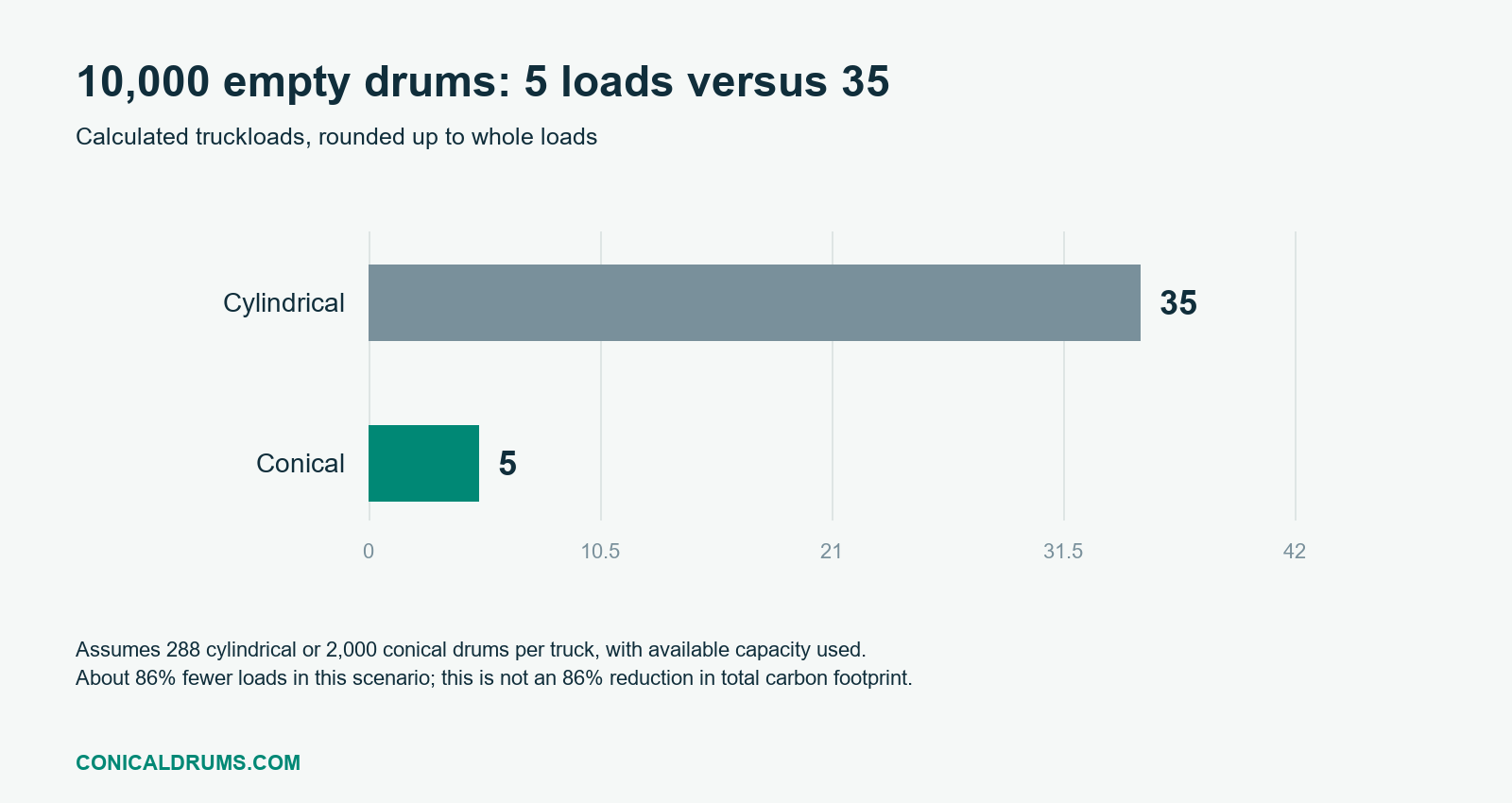
The reduction in truckloads should not be confused with a reduction in total carbon footprint. Transport is only one contributor; steel production, drum manufacturing and other activities within an assessment also matter.
Lower material use can add to the benefit
Conical steel drums can be lighter than comparable cylindrical drums, depending on their specifications. Where a suitable design uses less steel, it also requires less raw material per drum.
Material savings must be assessed against the intended application. Capacity, wall thickness, coatings, closures and handling requirements all affect whether two drums are a meaningful comparison. A lighter container still needs to meet the required performance and product-protection standards.
Understanding the carbon figures
The supplied analysis compared 10,000 conical drums with 10,000 standard cylindrical drums and reported savings of up to 103,997 kg of CO₂ equivalent (CO₂e) — approximately 104 metric tonnes. It also reported a maximum carbon-footprint reduction of 35%.
For scale, dividing 103,997 kg by an assumed passenger-car emission rate of 0.160 kg of CO₂ per kilometre gives approximately 650,000 kilometres of driving, or about 16 trips around the equator using a circumference of 40,075 km.
This is an illustrative emissions equivalence using a fixed assumption, not a claim about the emissions of every car or a complete vehicle life-cycle comparison.
Choosing the right drum for the job
Conical steel drums are used for products such as tomato paste and fruit concentrates. The supplied product overview describes capacities from 60 litres to more than 220 litres and steel thicknesses from 0.5 to 0.8 mm, along with internal coatings, external paint and several lid materials.
Specifications and availability vary by supplier. Buyers should confirm product compatibility, closure performance, handling needs and any required certification for the exact drum configuration. Applications requiring UN-approved packaging need a suitable certified version.
For procurement teams, the useful question is how the complete packaging system performs: the drum, its protection of the contents and the logistics needed to deliver it. Conical drums offer a compelling opportunity where empty-container transport is a significant part of that system.
Data and methodology note: Reported carbon figures and loading capacities come from the supplied comparative analysis. Its full methodology, system boundaries and independent verification were not provided. The results are scenario-specific and should not be treated as a universal guarantee or as research conducted by ConicalDrums.com. Ratios, truckload counts and driving equivalents are calculations based on the stated inputs. The two reported carbon maxima are presented separately; the available information does not establish whether they describe the same scenario.